AP Chemistry Virtual Labs
Free PhET simulations mapped to each unit, and what actually counts toward the real 25% lab requirement.
AP Chemistry requires that 25% of instructional time go toward hands-on lab work, and for a lot of students, especially those self-studying, in a virtual school, or at a school without a full chemistry lab, that sounds like a hard requirement to meet on your own. It isn't. College Board's own guidance is more flexible than most students realize, and there's a specific, free, well-known tool built for exactly this situation.
What Actually Counts, According to College Board
This isn't a workaround or a gray area. College Board's Course Audit guidance states directly that if a school can't provide onsite access to a lab environment, instruments, or materials, the hands-on requirement can be met through virtual labs, simulations paired with real student data collection and analysis, or labs that can be safely conducted at home. The one condition that doesn't change: every experience still needs a supervising science educator, and the student has to record and maintain it, the same expectation as a physical lab notebook.
PhET: The Free Simulation Platform Built For This
PhET Interactive Simulations is a non-profit project at the University of Colorado Boulder, founded in 2002 by Nobel laureate Carl Wieman. It offers over 100 free science and math simulations, no account or payment required, and a real chunk of them map directly onto specific AP Chemistry units rather than being generic "chemistry games."
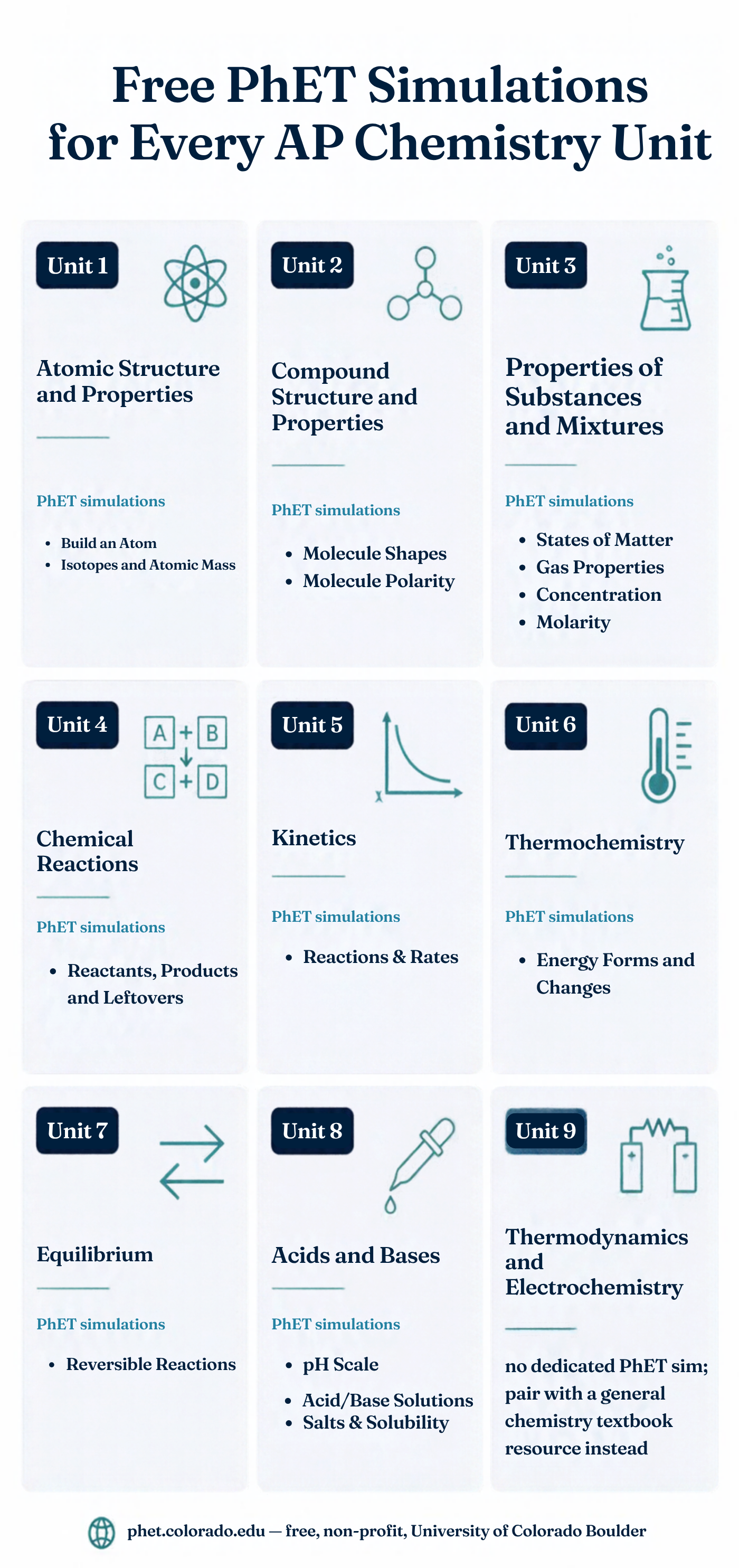
All simulations are free at phet.colorado.edu, a non-profit University of Colorado Boulder project.
Simulations by Unit
- Unit 1 (Atomic Structure and Properties): Build an Atom, Isotopes and Atomic Mass
- Unit 2 (Compound Structure and Properties): Molecule Shapes, Molecule Polarity
- Unit 3 (Properties of Substances and Mixtures): States of Matter, Gas Properties, Concentration, Molarity
- Unit 4 (Chemical Reactions): Reactants, Products and Leftovers, Balancing Chemical Equations
- Unit 5 (Kinetics): Reactions & Rates
- Unit 6 (Thermochemistry): Energy Forms and Changes
- Unit 7 (Equilibrium): Reversible Reactions
- Unit 8 (Acids and Bases): pH Scale, Acid-Base Solutions, Salts & Solubility
- Unit 9 (Thermodynamics and Electrochemistry): no dedicated PhET simulation currently exists for this unit specifically
That last gap is worth being upfront about. Not every unit has a matching simulation, and pretending otherwise wouldn't actually help you meet the requirement. For Unit 9, a supervising educator would need to structure an alternative hands-on or data-based activity instead.
Turning a Simulation Into a Real Lab Record
Running a PhET simulation by itself isn't the same as completing a lab. The requirement specifically calls for data collection and analysis, so a simulation session that counts looks like: a stated question or hypothesis, values you actually changed and recorded (not just watched), a brief written analysis of what the data showed, and your educator's confirmation that they supervised it. That's a low bar to clear, but it is a real one, not just clicking through the sim.
Related Resources
- Best Free AP Chemistry Resources
- AP Chemistry Study Guide
- AP Chemistry Solubility Rules
- AP Chemistry Units (All 9)
- AP Chemistry Course and Exam Description
Frequently Asked Questions
Do virtual labs actually count for AP Chemistry's lab requirement?
Yes, under specific conditions. College Board's own Course Audit guidance states that if a school can't provide onsite lab access, instruments, or materials, the 25% hands-on lab requirement can be met through virtual labs, simulations accompanied by real student data collection and analysis, or labs safely conducted at home. Every experience still has to be supervised by a science educator and recorded by the student.
What is PhET, and is it actually free?
PhET Interactive Simulations is a non-profit project at the University of Colorado Boulder, founded by Nobel laureate Carl Wieman in 2002. It offers over 100 free science and math simulations, chemistry among them, with no account, payment, or login required to use them.
Which PhET simulation should I use for equilibrium?
Reversible Reactions is the PhET simulation that matches Unit 7 (Equilibrium) directly, letting you watch a reaction approach equilibrium and see how concentration changes over time.
Do I need to submit anything to prove I did a virtual lab?
Yes. College Board's guidance requires that the experience be recorded and maintained by the student, the same expectation as a physical lab notebook. Simply clicking through a simulation without collecting or analyzing any data doesn't satisfy the requirement on its own.
Are PhET simulations enough to fully replace physical labs for AP Chemistry?
College Board allows it when physical lab access genuinely isn't possible, but it's framed as a substitute for specific circumstances, not a universally preferred replacement. A supervising science educator still has to structure the experience and confirm it meets the same 25% instructional-time expectation as in-person lab work.
This page is not affiliated with or endorsed by College Board or PhET Interactive Simulations. AP® is a trademark registered by the College Board.