AP Chemistry Score Conversion
How raw section scores become a weighted composite — and an estimated AP score.
The AP Chemistry exam has two sections that look very different on paper — 60 multiple-choice questions versus 7 free-response questions — but College Board weights them equally toward your final score. That single fact trips up a lot of students, since it's easy to assume the section with more questions counts for more. It doesn't. The five steps below show exactly how a raw MCQ count and a raw FRQ rubric score become one 0–100 composite, and how that composite maps to an estimated AP score.
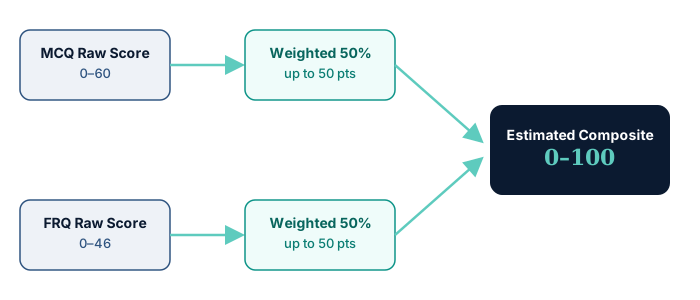
MCQ and FRQ are scored on different scales, but each is weighted equally toward the final composite.
Step 1: Raw Scores
Each section produces its own raw score first, on its own scale, before any weighting happens:
- MCQ raw score: number correct out of the 60 multiple-choice questions (90-minute section).
- FRQ raw score: total rubric points earned out of 46, across all 7 free-response questions (105-minute section — 3 long questions worth up to 10 points each, and 4 short questions worth up to 4 points each).
Why 50/50, Not Question Count
Because MCQ has 60 questions and FRQ has only 7, it's tempting to assume MCQ carries more weight. It doesn't — each section is converted to a percentage of its own maximum first, and only then weighted equally. A single free-response question is worth far more per-question than a single multiple-choice question, which is exactly what keeps the two sections balanced at 50/50 despite the very different question counts.
Step 2: Convert to Percentages
MCQ percentage = MCQ raw ÷ 60
FRQ percentage = FRQ raw ÷ 46
Step 3: Apply the 50/50 Weighting
MCQ weighted contribution = MCQ percentage × 50
FRQ weighted contribution = FRQ percentage × 50
Step 4: Estimated Composite
Estimated composite = MCQ weighted contribution + FRQ weighted contribution
This yields a score from 0 to 100.
Worked Example
| Metric | Value |
|---|---|
| MCQ correct | 42 / 60 |
| MCQ percentage | 70.0% |
| MCQ weighted contribution | 35.0 / 50 |
| FRQ raw score | 29 / 46 |
| FRQ percentage | 63.0% |
| FRQ weighted contribution | 31.5 / 50 |
| Estimated composite | 66.5 / 100 |
A Second Example: Weaker MCQ, Stronger FRQ
Because the two sections are weighted equally, a student with a very different MCQ/FRQ balance can land at almost the same composite as the example above:
| Metric | Value |
|---|---|
| MCQ correct | 33 / 60 |
| MCQ percentage | 55.0% |
| MCQ weighted contribution | 27.5 / 50 |
| FRQ raw score | 36 / 46 |
| FRQ percentage | 78.3% |
| FRQ weighted contribution | 39.1 / 50 |
| Estimated composite | 66.6 / 100 |
A markedly weaker MCQ performance (55% vs. 70%) is fully offset by a stronger FRQ performance (78.3% vs. 63%), landing at essentially the same composite as the first example. Neither section on its own would predict the final estimate — only the weighted combination does.
Step 5: Estimated AP Score
This site maps the 0–100 composite against configurable, publicly documented estimated score ranges to suggest a likely AP score (1–5). These ranges are not official College Board cutoffs — College Board does not publish a universal raw-score conversion table. See our full methodology for how these ranges are built and reviewed.
Review by Unit
A weak MCQ or FRQ score often traces back to a specific unit. Review any of the 9:
- Unit 1: Atomic Structure and Properties
- Unit 2: Compound Structure and Properties
- Unit 3: Properties of Substances and Mixtures
- Unit 4: Chemical Reactions
- Unit 5: Kinetics
- Unit 6: Thermochemistry
- Unit 7: Equilibrium
- Unit 8: Acids and Bases
- Unit 9: Thermodynamics and Electrochemistry
Related Resources
- AP Chem Score Calculator
- AP Chemistry Study Guide
- AP Chemistry Practice Tests
- AP Chemistry Curve by Year
- AP Chemistry FRQ Scoring
- Full Methodology
FAQ
Why are MCQ and FRQ weighted 50/50 if MCQ has more questions?
The 50/50 split is by point value, not question count. The 60 MCQ questions are each worth a small fraction of the section, while each FRQ question is worth several rubric points, so the two sections end up contributing equally to your composite even though they look very different in question count.
Can I estimate my score from just one section?
Yes, but it only tells you half the picture. Our MCQ Calculator and FRQ Calculator show that section's weighted contribution out of 50, not a full 1-5 estimate, since the other section is still unknown.
Does a stronger FRQ score make up for a weaker MCQ score?
Yes, because the two sections are weighted equally, a stronger performance on one section can offset a weaker performance on the other. The worked examples below show two different MCQ/FRQ combinations landing at a similar estimated composite.